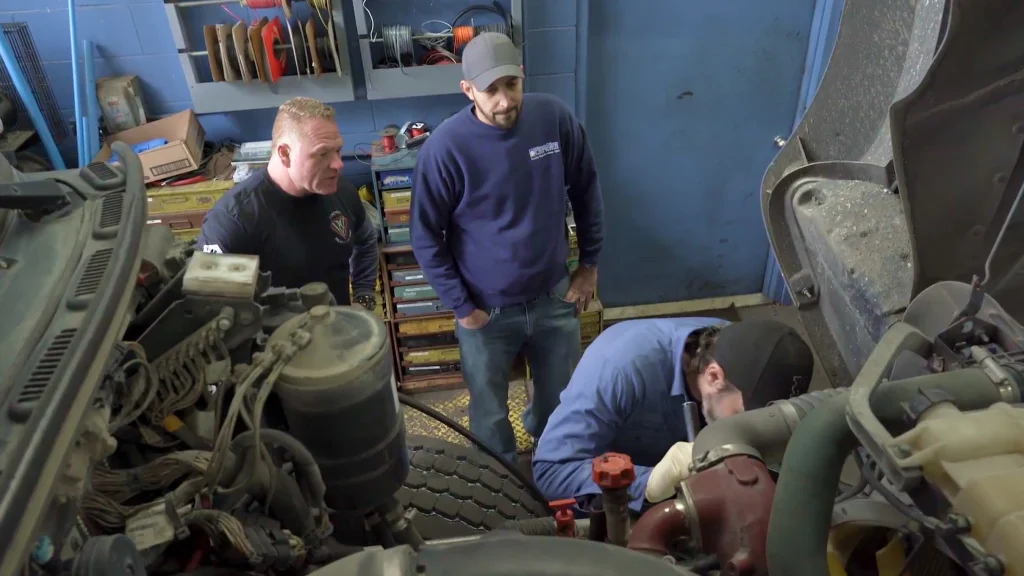

Ever relied on your turbo to help you rev up to top speeds for important deadlines and situations?
Your turbo charger is a key part of your engine: it helps you accelerate fast and safely reach top speeds. But if your turbo stops working, you could experience engine issues, poor engine performance, and inefficiencies that can cause delays, or worse, breakdowns.
How does one identify turbo failure symptoms? What should they look for?
Pine Aire here. Let us give you a hand in identifying seven key turbo failure symptoms so you can keep your truck rockin’ and rollin’ when it’s crunch time.
In this article, we’ll take a look at the following turbocharger-related topics:
- How turbochargers work
- What causes them to fail
- 7 key symptoms indicating a failed turbocharger
- Driving on a failed turbocharger
Turbocharger failure symptoms to be aware of

| 1. Poor acceleration and/or loss of engine power 2. Greyish, blue smoke and increased emissions exhaust 3. Check engine light goes on 4. The boost gauge becomes inactive 5. Whining and siren-like sounds come from the turbocharger 6. Loud noises upon starting up the truck |
How does air move through turbochargers?

Before we look at the symptoms, we need to understand how turbochargers work, specifically the way air moves through the engine. Air helps power up the combustion needed to help your engine perform at its best.
By using exhaust fumes from the engine to spin an air pump, the turbo draws extra power from the engine. In other words, the turbo makes use of the energy produced from expelled exhaust gases.
An air pump then pushes the extra air into an engine, increasing the engine’s horsepower, and thereby giving your truck the “turboboost” of power it needs to drive at faster speeds.
Nevertheless, if any parts, processes, or mechanisms fail while the air moves through the turbocharger, the turbocharger can fail.
What causes turbochargers to fail?

Diesel truck turbochargers tend to fail for the following reasons:
- Lack of oil and lubrication under the hood: turbochargers need clean oil to work at peak capacity. If oil isn’t flowing to the turbocharger, carbon deposits and contaminants can build up inside the system, thereby reducing its effectiveness and causing breakdowns over time.
- Debris build-up: broken parts, stones, and chunks of debris can often lodge themselves in the turbo. The result is damaged wheels and blades in the turbo. One way to solve this is by checking air filters, opting for regular truck preventive maintenance, and dislodging particles where possible.
- Wear and tear: speaking of worn out, eventually, a turbocharger will wear out. With that being said, turbochargers can last for 100,000 miles or more, depending on how they’re used.
- Excessive issues with the exhaust system: Excessive exhaust gas temperatures (EGT) can overheat parts. Also, as moisture enters the turbocharger, rust can occur, which can degrade parts. What’s more, if the exhaust system, fuel intake, and other components are damaged, a turbocharger can fail.
So, we now have a basic understanding of what can cause a turbocharger to fail. But, what does a failed turbocharger look like? In other words, how can we tell if a turbocharger has failed?
Let’s take a look at seven key indicators of a failed turbocharger.
7 signs of a failed turbocharger

The seven most common signs of a failed turbocharger on a diesel truck include:
- Loss of power and slow acceleration: the turbocharger is designed to make your vehicle reach top speeds faster. If you notice that your vehicle is taking longer to speed up and can’t move through traffic like it used to be able to do, we recommend checking the turbocharger pronto.
- Smoky exhaust and excessive emissions: if your truck experiences problems with worn seals or cracks in the turbocharger, exhaust can enter the turbocharger. One way to know whether smoky exhaust and excessive emissions occur is through greyish, blue smoke emitted from the exhaust system. You may notice this phenomenon when driving at a regular speed. If you notice greyish, blue exhaust smoke in your rear-view mirror, the turbo could be the culprit.
- Check engine light turns on: The check engine light can turn on for many reasons, but in case it does, bring your vehicle in for speedy truck repairs to prevent further potential issues with the turbocharger.
- Inactive boost gauge: If you notice a drop in the boost on your boost gauge, your turbocharger could use an inspection or service intake.
- Burning oil: if you notice a burning oil smell, oil could be leaking into the turbocharger. When oil leaks, the leaks can lead to gradual failure. To inspect the issue, you can disconnect the drain pipe in the turbo and look inside of it for signs of deposits in the pipe. If gone unchecked, your entire engine system can suffer.
- Whining turbo: Siren-like sounds coming from the turbo while it’s engaged can indicate a failing or already-failed turbo.
- Loud noises upon startup: especially from under the hood, if you hear whistling, rattling, or hissing, your turbocharger might be failing.
Is it okay to operate a truck on a failed turbo?
The short answer is no. If you notice smoke coming from where the turbocharger is, you definitely don’t want to drive the vehicle.
But, if you must operate your vehicle, we recommend stopping the car, removing the intake, and checking the shaft first. In fact, you can drive without the turbo, but it’s always safer to have a tow truck take you to the nearest mechanic versus driving.
Did you know?

Did you know that a simple, 5-minute daily pre-trip inspection can save you hundreds of dollars in unneeded repairs for parts like your turbocharger?
Curious to learn how it’s done? Listen to John Sganga, our service manager here at Pine Aire Truck, teach drivers what to expect when conducting a 5-minute daily pre-trip inspection.
Final thoughts to remember regarding turbo failure symptoms

As we wrap up, we wanted to let you know a couple of final thoughts. When your turbo fails, the pieces can enter other parts of your engine and cause massive destruction.
A worn turbo could allow lubricating oil to bypass and go into the combustion chambers, allowing the engine to run on the oil until there is no more. The result? No lubrication and catastrophic engine failure can occur.
Surprisingly, an engine can run on this oil. And when it does, it’s awful and a terrible scene.
If you come to the point where your turbocharger fails, consult us immediately. Don’t run the engine and consult your local truck repair shop as soon as possible.
Your shop has the knowledge, expertise, and tools to fix your truck and keep it working for the road ahead.
Have more questions about turbochargers? Don’t hesitate to reach out to us. We’d be happy to lend a hand and ensure you and your truck are ready for the road.
Service Beyond Expectation Since 1986