A failing what? Yes, a failing front or rear differential is a complex internal gear system used to help transfer torque to the wheels of your vehicle. Understanding the symptoms of a failing or bad differential is key to ensuring the health and longevity of your diesel truck.
Since the differential transfers power to your vehicle’s wheels from the engine, keeping it in tip-top shape is essential to keeping your truck in motion. In fact, most of us don’t think twice about it until it’s failing, and unfortunately, by then, repairing it may be too late.
If you’re wondering whether something’s up with your transmission, the issue could be your differential. Since the differential is either on the front or rear wheels, depending on your truck’s drivetrain, keeping it in shape is essential.
But, if you’re looking for the symptoms of a failed or bad differential, you’ve come to the right place.
Join us! In this article, we’ll describe 10 of the most common symptoms of a failing or bad differential, along with ways to prevent differential failures, and what to expect if you need repairs on a differential.
10 symptoms that may cause a failed or bad differential

| 1. Noises coming from the driveline/transmission 2. Worn differential parts 3. Handling and steering 4. Grinding noises coming from the gears 5. Tire damage 6. Oil leaks and spills 7. Issues with the driveshaft 8. Burning smells 9. Vibrations 10. Uneven wear on tires |
1. Various noises (clunking, howling, hissing, and more)
If you hear any of the following noises — clunking, howling, hissing, whirring, or whining — coming from under your truck, you could be experiencing a failed differential. You may find that, depending on how you drive and the conditions of the road, you might experience different types of sounds.
For example, humming or loud howling noises may indicate worn-out components or damage to various parts. If accelerating on the road with a bad differential, you may even hear clunking or clicking noises.
2. Worn differential parts
Replacing worn parts is crucial to keeping a differential in working condition.
Worn bearings, gears, and other components can cause unsmooth operations, which can cause parts to overheat. In fact, excessive strain on bearings, pins, internal gears, and other components can cause a differential to overheat and fail.
3. Handling and steering issues
Speaking of driving vehicles for a long time, if you notice that turning corners is challenging, or if you notice that your truck tends to pull to one side, your vehicle could be experiencing a failed differential.
The reason that steering issues may cause differential issues is that the rear differential may not be distributing power evenly to each of the wheels. As a result, turning can feel stiff.
If the differential tends to pull to one side, the pulling may be a result of a worn or damaged differential, which can result in uneven distribution of power across the axles.
4. Gear grinding
If your differential isn’t working properly, the internal gears within the differential system could be wearing out. You’re more likely to hear or experience grinding gears when turning around a corner or accelerating.
5. Tire damage
While not always a cause of a failed differential, tire damage can reveal that damage exists within a front or rear differential. If you notice damage along the outer tires, you could be experiencing a failed differential.
6. Oil leaks and spills
One of the many signs of a failing differential is a lack of lubrication. To keep differential components working, an appropriate amount of lubrication is necessary. When parts wear out they cause excessive movement that damages seals and creates leaks.
If not addressed, the loss of lubrication could cause catastrophic damage to many components — and large repair bills!
If you notice oil or other fluid pooling under the axles of your car, you could be experiencing a bad or failed differential.
7. Driveshaft issues
A bad or failed differential can cause issues with driveshafts. For example, if driving on a bad differential, your vehicle may shudder or turn with greater difficulty.
What’s more, if you notice vibrations, clicking, or other strange noises coming from under your vehicle, you may have a driveshaft that needs attention. Driveshafts, universal joints and carrier/hangar bearings can also be damaged by a failing differential.
A properly trained technician should inspect the complete driveline when servicing your truck, regardless of whether you’re experiencing problems.
8. The smell of burning
Another one of the common signs that a differential is failing is if you notice burning smells coming from your vehicle. If you smell something burning from under your truck, there may be a problem and this should be checked immediately.
Many times, smaller problems lead to larger problems, so early detection is critical.
If differential components aren’t checked on a timely basis, they won’t run smoothly. Faulty components can cause a transmission or driveline components to overheat, which can then result in burning smells.
If you notice your truck’s driveline is experiencing issues or emitting a foul-smelling odor, take your vehicle to your nearest truck repair facility.
9. Vibrations under the chassis
Vibrations under the seat or floor of your truck that become more severe with acceleration could be the result of two different components not working. If you feel vibrations coming from under your seat, you might be experiencing issues with one of these two components:
- Driveshaft
- Worn-out differential gears
We recommend bringing your vehicle to a repair facility pronto, as driving with a faulty driveshaft or worn-out differential gears can quickly become expensive.
10. Uneven wear on tires
Premature or uneven wear and tear may indicate that the differential gears aren’t working properly.
If tires rotate at different speeds, the uneven rotations can cause the interior of a tire to wear down faster than the outer part of the tire. You’ll often find the most uneven wear on front-wheel tires, as the front tires often handle the greatest stress and loads, especially when turning corners.
With that being said, uneven wear on front- and rear-wheel tires doesn’t always indicate a failing differential. In fact, premature wear and tear can also occur as a result of misaligned wheels, wheels that are over- or under-inflated, or poor suspension.
By bringing your truck in for regular preventive maintenance, you can prevent misalignment in the first place and keep your vehicle operating as it should.
Ways to prevent differential failures and maintain their health
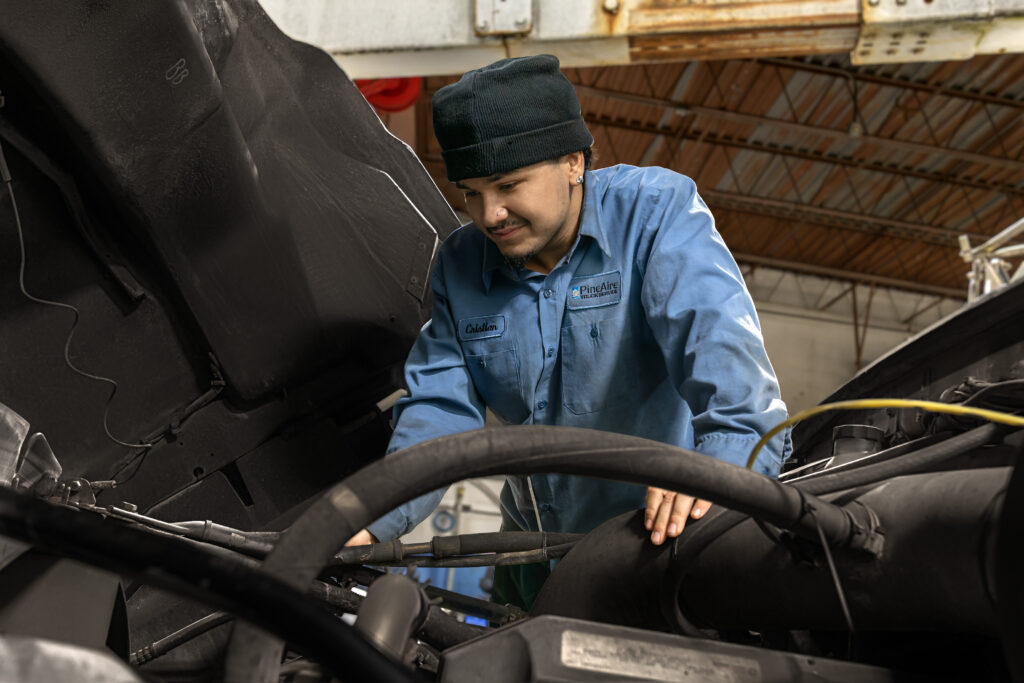
So, now that we know the various symptoms of a failing or bad differential, how can we prevent it? That’s the most important question of all, isn’t it?
- Keep your oil at appropriate levels: even a tiny leak can translate to components in your differential grinding against each other. If you’re uncertain about when to top up your oil levels, bring your truck to a diesel truck repair technician.
- Use the right oil: Though this piece of advice may sound like a no-brainer, make sure you’re using the right kind of oil for your truck. The wrong oil can cause malfunctions. Transmissions, differentials, and engines all use very specific oils. Check with your manufacturer before adding any fluids. If in doubt, an up-to-date truck shop will know what lubricants belong in your truck.
- Replace truck components according to the manufacturer’s specifications: Differentials tend to last a long time, but they need regular service to ensure optimal performance. To prevent internal damage and costly parts replacements, and to maximize mileage and power from the engine, we recommend having your truck inspected by a certified mechanic every few months.
What happens during a differential repair?

If you’ve tried everything but still feel your differential repair needs work, here’s what you can expect when your certified mechanic inspects and repairs a failed differential:
- Your mechanic will drain and replace the differential fluid.
- They’ll replace worn gears and/or bearings.
- They’ll reseal or replace gaskets, depending on the scope of the repair.
- They’ll rebuild or replace the entire differential if the differential is severely damaged.
While we hate to see drivers have to repair a differential before it’s needed, if you must replace your truck’s differential, we always recommend bringing it to a diesel truck repair technician. A diesel truck technician can identify early warning signs and help you maintain the life of your differential without the guesswork of repairing it yourself.
Food for thought: when your differential needs to be repaired…
With a diesel truck repair team, you’ll almost certainly save money, time, and stress on your next differential repair. By leaning on the expertise and experience of a trusted diesel mechanic, you can ensure a safer ride and smoother operation.
Long-lasting differentials begin with regular preventive maintenance
At the end of the day, the best offense is a great defense. When applying this axiom to your truck, we like to think that a healthy truck begins with regular preventive maintenance.
If you’re looking to avoid transmission, differential problems, and unnecessary downtime, you need to conduct regular repairs on your truck. Bringing your vehicle to a diesel truck repair team is a sure-fire way to ensure your engine and differential operates long and strong.
If you live on Long Island, NY, and need a dependable, helpful, and trusted diesel repair technician, pop on over to Pine Aire Truck. Since 1986, we’ve been delivering service beyond expectation to all of our clients.
No gimmicks, no sales tactics, and no lemons — just quality service at a fair price.
If your engine or differential needs repairs, contact us today. Our customer service team would be happy to help.
Until then, best of luck on the road ahead, and we wish you all the best on your travels.
Pine Aire Truck: Reliable Diesel Truck Repairs Since 1986